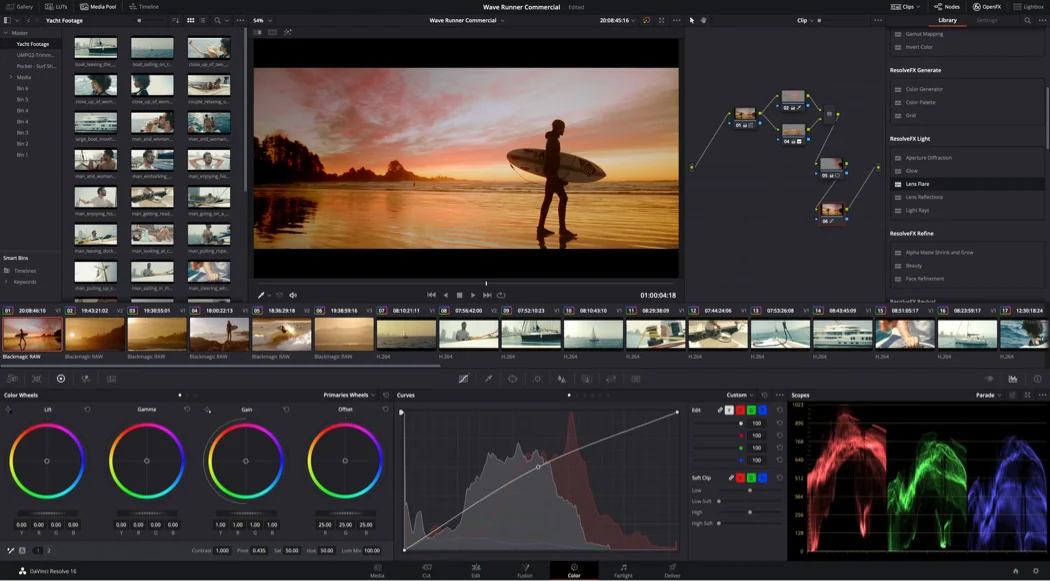
The image
The reference object is Blackmagic Design's own DaVinci Resolve 21 Reference Manual, retrieved on 16 September 2026, together with the company's DaVinci Resolve Color product page. Neither is a photograph; both are current product documentation describing settings and menus rather than any graded frame.
What the documents show
The manual states that color management in Resolve depends on a Color Science setting with four options: DaVinci YRGB, DaVinci YRGB Color Managed, and two ACES-based modes, ACEScc and ACEScct. It distinguishes the default YRGB mode, described as Display Referred, meaning Resolve holds no information about a clip's intended appearance beyond what a calibrated display shows, from Resolve Color Managed mode, introduced in Resolve 12 and described as Scene Referred, which matches each imported clip's native color space to a shared timeline working space using profile-based transforms rather than manually assigned look-up tables. The manual states a specific technical tradeoff: transforms in the color-managed mode preserve wide-latitude image data through matrix operations, whereas LUTs, in the manual's own words, can clip out-of-bounds image data. The product page adds that Resolve supports both its own color-management system and the Academy Color Encoding System as defined by the Academy of Motion Picture Arts and Sciences, naming ACES as a second, separate documented option rather than a mode built into Resolve's own scheme.
Production context
This is an editorial reading of the documented options. A facility mixing footage from multiple camera systems, the manual's own example compares Blackmagic Film color space against Sony's SGamut3.Cine/SLog3, faces a documented reason to choose a color-managed or ACES mode over manual LUT assignment: matching how different cameras render the same subject inside one shared timeline without hand-building a LUT for every source format.
Reference versus imitation
The manual documents four named settings and describes tradeoffs between them; it does not describe any one setting as producing a correct or superior final image, stating instead that Resolve Color Managed doesn't do the grading for the colorist. Citing color-managed grading as though it names one universal correct method, rather than one of four documented configuration choices, overstates the manual's own framing.
- Is a cited grading workflow naming the specific Color Science setting the manual documents, or treating color management as one undifferentiated feature?
- Does the source distinguish Display Referred from Scene Referred handling, as the manual itself does?
- Is the manual version being cited current, given that Blackmagic revises this document with each Resolve release?
The manual and product page together establish a documented set of configuration choices inside one application. They do not establish that any configuration determines a finished image's look on its own, apart from the grading decisions the manual repeatedly leaves to the colorist.
Sources & reading trail
Documents the four Color Science modes, Display vs. Scene Referred handling, and LUT-clipping tradeoffs.
Source published: Not established · Retrieved: 16 September 2026
States that Resolve supports its own color management system alongside ACES.
Source published: Not established · Retrieved: 16 September 2026
Records, documentation and rulings establish the entry; the reference-versus-imitation reading is Screen Visual Lab editorial analysis. This retrospective draft does not imply the site published on the event date.