The image
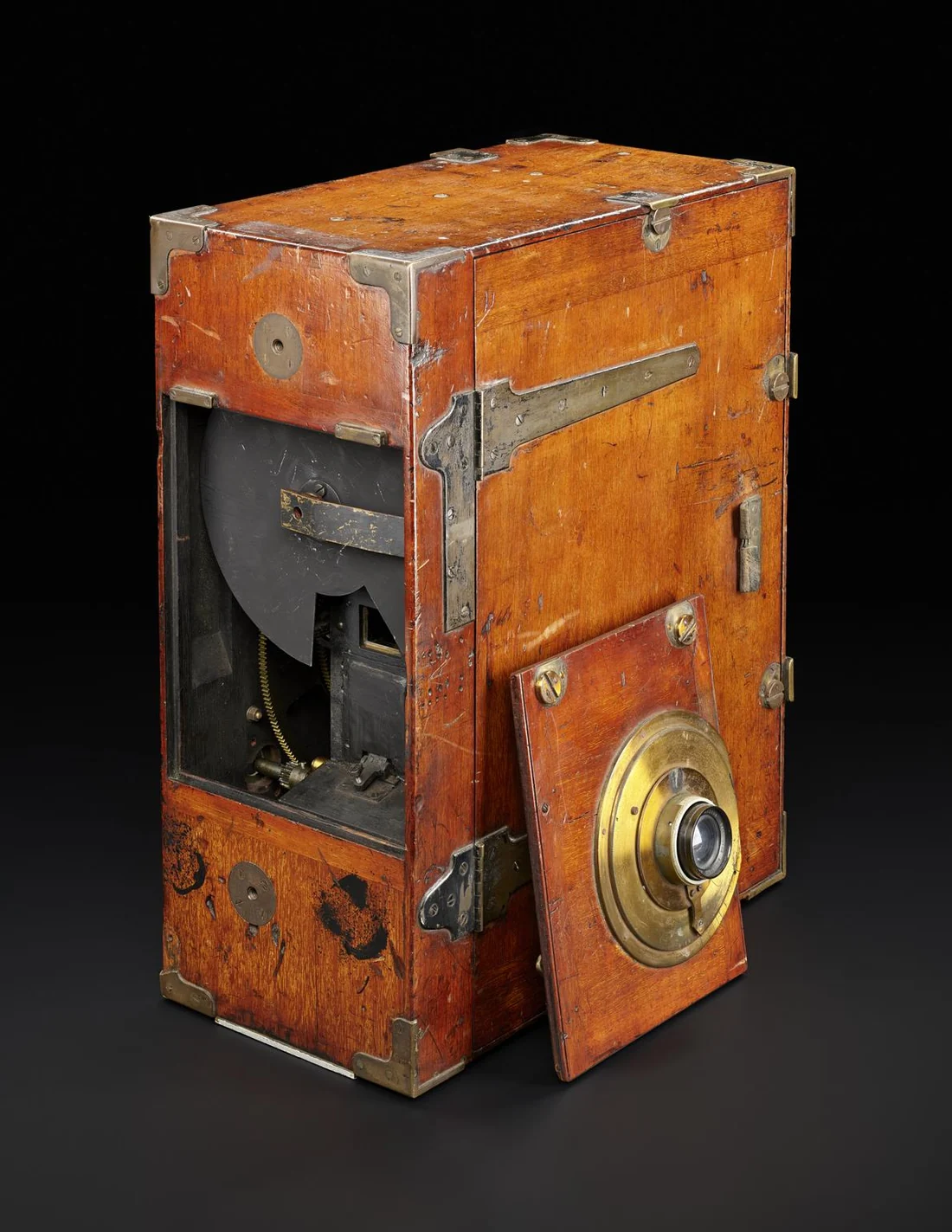
The object is a 'No 1 Kinemacolor Camera,' made in London in 1909 and now held by the National Science and Media Museum, which catalogues it as built by the Natural Color Kinematograph Company Limited with a Dallmeyer lens, under Urban Patent 8348. A companion object at the George Eastman Museum, a Kinemacolor projector credited to the Charles Urban Trading Co., Ltd., is separately catalogued there at circa 1906, alongside surviving Kinemacolor prints of the 1913 feature 'The Scarlet Letter.' Together the two collections document the camera, the projector, and the release prints of a single color system, each credited to its own maker.
What the documents show
The Science Museum Group's own description states the mechanics plainly: Kinemacolor was 'a two-colour additive colour process, photographing and projecting a black-and-white film behind alternating red and green filters,' invented by George Albert Smith in 1906 and 'developed and run by Charles Urban and his Natural Color Kinematograph Company Limited,' used commercially from 1909 to 1914. The record credits Smith with invention and names an earlier process, the Lee and Turner three-colour system, as what Smith's design built on, rather than crediting Smith with inventing color cinematography outright. The Eastman Museum's separate catalogue, holding its own projector and prints, corroborates that the hardware and film survive in more than one archive.
Production context
Editorially, a black-and-white negative run behind rotating red and green filters is a materially different image chain from a process exposing three separate color-record negatives: only two color bands are captured, so the projected image could reconstruct reds and greens but not the fuller spectrum a three-color process later achieved. That constraint, rather than any studio marketing description, is what the surviving apparatus itself demonstrates, since a camera or projector built for only two rotating filters cannot physically record more than two color channels.
Reference versus imitation
Describing a modern digital 'look' as 'Kinemacolor-inspired' without naming the specific two-filter, red-green mechanism misrepresents what the process could and could not do; its limited palette was a hardware constraint, not a deliberate aesthetic choice available to later filmmakers working in full color. A reference note that credits Kinemacolor properly should specify the additive two-color mechanism and its 1909-1914 commercial window, attributing the description to the museum records documenting the surviving cameras, projectors, and prints, rather than to an assumed vintage color grade.
- Does the reference name the specific two-color mechanism rather than a generic 'vintage' look?
- Which colors could the process actually reproduce, and which could it not?
- Is the surviving hardware or print record, not a studio's promotional account, the source for the claim?
Two separately maintained museum collections, one in Bradford and one in Rochester, now hold the physical evidence of what Kinemacolor's red-and-green filter system actually produced, and both credit the same maker and inventor rather than treating the process as anonymous period color.
Sources & reading trail
Describes the camera's 1909 manufacture, patent, and the process's additive two-color red/green filter mechanism and 1909-1914 commercial run.
Source published: Not established · Retrieved: 16 September 2026
Catalogues a separate Kinemacolor projector (ca. 1906) and Kinemacolor prints of a 1913 feature.
Source published: Not established · Retrieved: 16 September 2026
Records, documentation and rulings establish the entry; the reference-versus-imitation reading is Screen Visual Lab editorial analysis. This retrospective draft does not imply the site published on the event date.