The image
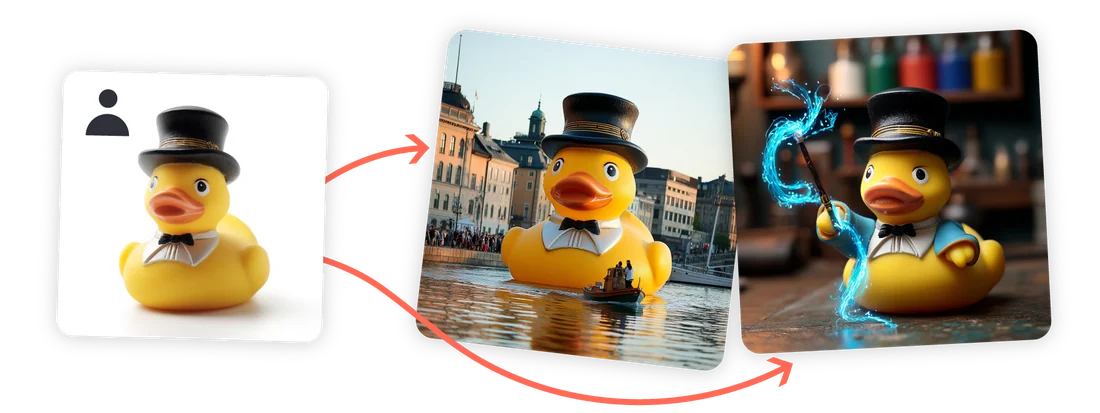
Midjourney's own Legacy Features page and its Omni Reference page, both current as of this reading on 16 September 2026, are the documents here rather than any single output. The Legacy Features page shows the older Character Reference workflow — an image placed in a labeled section of the Imagine bar — while the Omni Reference page shows its documented successor, the same upload step feeding a differently named control.
What the documents show
The Legacy Features page states that "Character Reference is a feature compatible with Midjourney and Niji version 6" that "allows you to recreate a specific character in multiple images, but was replaced by Omni Reference in V7, and the Edit Model in V8.X." It documents the Discord parameter "--cref" for the reference image and "--cw" for a character-weight value, stating the "default value is 100 (the maximum), but you can lower the value to narrow the details to just the face." The separate Omni Reference page, describing the current mechanism, states it lets a user "put characters, objects, vehicles, or non-human creatures from a reference image into your Midjourney creations" and warns that "intricate details like specific freckles or logos on clothing may not perfectly match your reference" — a limit the company states about its current tool, not one inferred here.
Production context
Read editorially, naming a separate weight parameter for character detail, adjustable down to "just the face," documents a control aimed at a working problem distinct from overall look — keeping one performer or character recognizable across many generated panels, closer to continuity tracking than to style-matching. That Midjourney's own page records this control's succession from --cref to Omni Reference to the Edit Model is a documented product history worth citing precisely when a workflow references any one of the three.
Reference versus imitation
Both the retired and current mechanisms condition generation on a specific uploaded reference image the user supplies, distinct in stated purpose from Style Reference's palette-and-texture conditioning; neither page claims guaranteed identical likeness, and the Omni Reference page's own caution about mismatched details is evidence the company frames this as best-effort recreation, not identity reproduction. Citing "Character Reference" as Midjourney's current feature without noting its documented replacement would misstate the product as it exists at the time of this reading.
- Is the workflow using the legacy --cref parameter, Omni Reference, or the Edit Model, and does the source specify which?
- What character-weight or equivalent value was set, and does the documentation describe it as affecting only facial detail?
- Does the cited documentation state guaranteed likeness, or only a best-effort match with named limitations?
A feature's documented succession — one parameter replaced by another, in the vendor's own words — is itself evidence worth recording, since it dates any claim about "how Midjourney keeps a character consistent" to a specific version rather than to the product in general.
Sources & reading trail
States that Character Reference (--cref, --cw) recreates a specific character and was replaced by Omni Reference in V7 and the Edit Model in V8.X.
Source published: Not established · Retrieved: 16 September 2026
Documents the current successor mechanism and states intricate details may not perfectly match the reference image.
Source published: Not established · Retrieved: 16 September 2026
Records, documentation and rulings establish the entry; the reference-versus-imitation reading is Screen Visual Lab editorial analysis. This retrospective draft does not imply the site published on the event date.