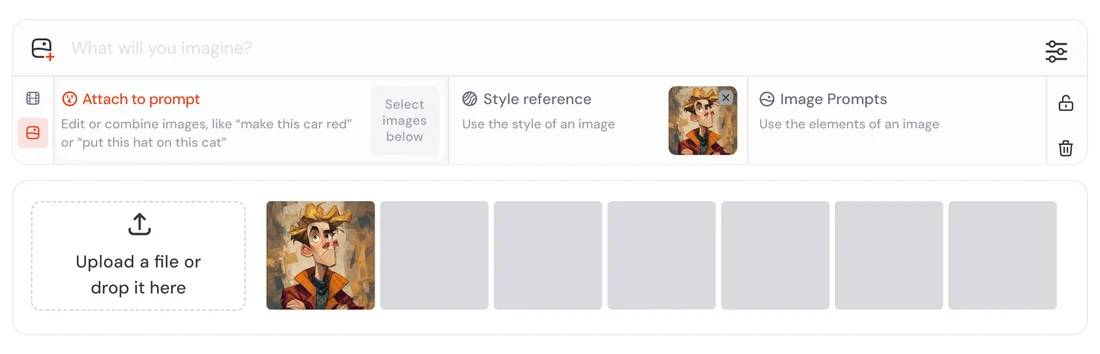
The image
Midjourney's own Style Reference help article, last updated 1 September 2026 at the time of this reading, is the document at hand rather than any single generated picture. It describes a feature reached by clicking the image icon in the Imagine bar or by appending the parameter "--sref" followed by an image URL in Discord, and it shows example pairings of a reference image beside new generations that carry over its palette or texture. As a living help page, its content reflects the product on the date retrieved, 16 September 2026, and can change again without a version number attached.
What the documents show
The article states plainly what the feature does and does not do: "It doesn't copy objects or people, just the overall style — like colors, medium, textures, or lighting." It documents a style-weight parameter, "--sw," ranging from 0 to 1000 with a default of 100, and a separate "Style Reference Code" system that applies a numbered look from what the article calls "the Midjourney internal style library" instead of an uploaded image. A second document, Midjourney's own Legacy Features page, corroborates the lineage: it records that a Discord-based "Style Tuner," used in version 5.2, was "one of the first steps" toward the personalization and style-code system the current article describes, and that the Style Tuner itself no longer accepts new submissions.
Production context
Read editorially, a documented style weight that a user can dial between 0 and 1000 offers a mood-board tool a numeric, repeatable setting rather than a vague verbal instruction, useful when a team needs to compare several strengths of the same reference against the same prompt. The article's own best-practice guidance — to keep text prompts focused on content rather than instructions like "copy this style" — indicates Midjourney documents the feature as sensitive to how it is prompted, not as a one-step transfer.
Reference versus imitation
The documentation is explicit that objects and people are not copied, only "overall style," which sets a documented boundary between reference and imitation for this specific parameter. A style-reference code, since it is drawn from an internal library rather than an uploaded image, carries no direct link to any external artist's work by the article's own account; an uploaded reference image, by contrast, is a specific file whose provenance and licensing remain the uploader's responsibility, a distinction the help article does not itself adjudicate.
- Was the style conditioned from an uploaded image or from a numbered internal style code?
- What style-weight value was used, and is it recorded alongside the output?
- Does the reference image's own license or source permit this use, a question the tool's documentation does not answer?
A help-center article is a snapshot of a live product; treating today's description of a parameter as permanent, or as evidence about any one artist's style being reproduced, goes beyond what the document itself claims.
Sources & reading trail
States that style reference conditions color, medium, texture and lighting rather than objects or people, and documents the --sref and --sw parameters.
Source published: Not established · Retrieved: 16 September 2026
Records that the version 5.2 Style Tuner preceded the current personalization and style-code system, corroborating the feature's documented lineage.
Source published: Not established · Retrieved: 16 September 2026
Records, documentation and rulings establish the entry; the reference-versus-imitation reading is Screen Visual Lab editorial analysis. This retrospective draft does not imply the site published on the event date.