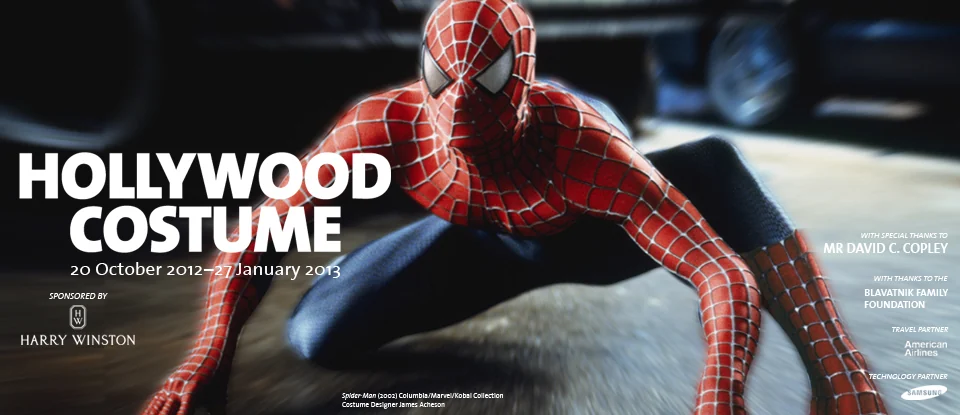
The image
A caption on the Victoria and Albert Museum's own exhibition page reads: 'Dorothy Gale costume from The Wizard of Oz, designed by Adrian, 1939.' The same page carries three further captioned stills used to introduce the show's structure: Harrison Ford as Indiana Jones (costume by Deborah Nadoolman), Kate Winslet as Rose in Titanic (costume by Deborah L. Scott) and Johnny Depp as Jack Sparrow (costume by Penny Rose). Each carries a rights line naming the studio and photo agency, for example 'Lucasfilm/Paramount/The Kobal Collection.' These are the objects the museum itself put in front of visitors to introduce the exhibition, not a later description of it.
What the documents show
The V&A's own pages state that Hollywood Costume ran as its 2012 autumn show, bringing together more than 100 costumes from a century of filmmaking, 1912 to 2012, arranged in sections the museum calls Deconstruction, Dialogue and Finale. The exhibition's home page names three curators: Deborah Nadoolman Landis, credited elsewhere on the site as Senior Guest Curator, with Professor Sir Christopher Frayling and Keith Lodwick. The about-the-exhibition page attributes each illustrated costume to one named designer and one film, narrower than the studio-era habit of crediting a whole picture's look to a single star. Quotes from designers and actors are presented as the museum's own selected lines, not independently verified transcripts.
Production context
The museum's account states that most exhibited garments had never left the private archival collections holding them in California and had not been publicly displayed before. Read as a working resource, that detail matters: the show briefly made physical, at close range, objects a costume researcher otherwise knows only from set photographs. The Deconstruction section is described as walking through a designer's research process using named case studies, including Fight Club and Raiders of the Lost Ark. This is an editorial read, but it follows the museum's own framing: a costume shown beside the brief that produced it is different evidence than the same costume shown alone.
Reference versus imitation
Every illustrated garment carries a named designer and a named rights holder. That double credit is the boundary the exhibition draws: a researcher may study how Adrian solved a character problem for Judy Garland's Dorothy, but the still photograph documenting that solution belongs to the studio and agency listed beside it, not to whoever reposts it. The designers' quoted lines describe intent in general terms and should not be stretched into a caption for a costume the same designer did not discuss. Copying a silhouette without naming the designer or film differs from citing the V&A's own record of who made it.
- Does the object carry a named maker, or only a film title and a guess?
- Is the photograph's rights holder named alongside the costume?
- Is a quoted design explanation attributed to the person recorded as having said it?
Read this way, the V&A's record of Hollywood Costume is less a celebration of glamour than a credit ledger: a hundred garments, each tied to a name, a film and a rights line, the kind of paper trail a visual reference practice depends on.
Sources & reading trail
V&A's own exhibition text describing the show's three-act structure and naming designers and photo credits for the illustrated costumes.
Source published: Not established · Retrieved: 16 September 2026
V&A's own landing page naming the three curators and describing the exhibition as its 2012 autumn show.
Source published: Not established · Retrieved: 16 September 2026
Records, documentation and rulings establish the entry; the reference-versus-imitation reading is Screen Visual Lab editorial analysis. This retrospective draft does not imply the site published on the event date.