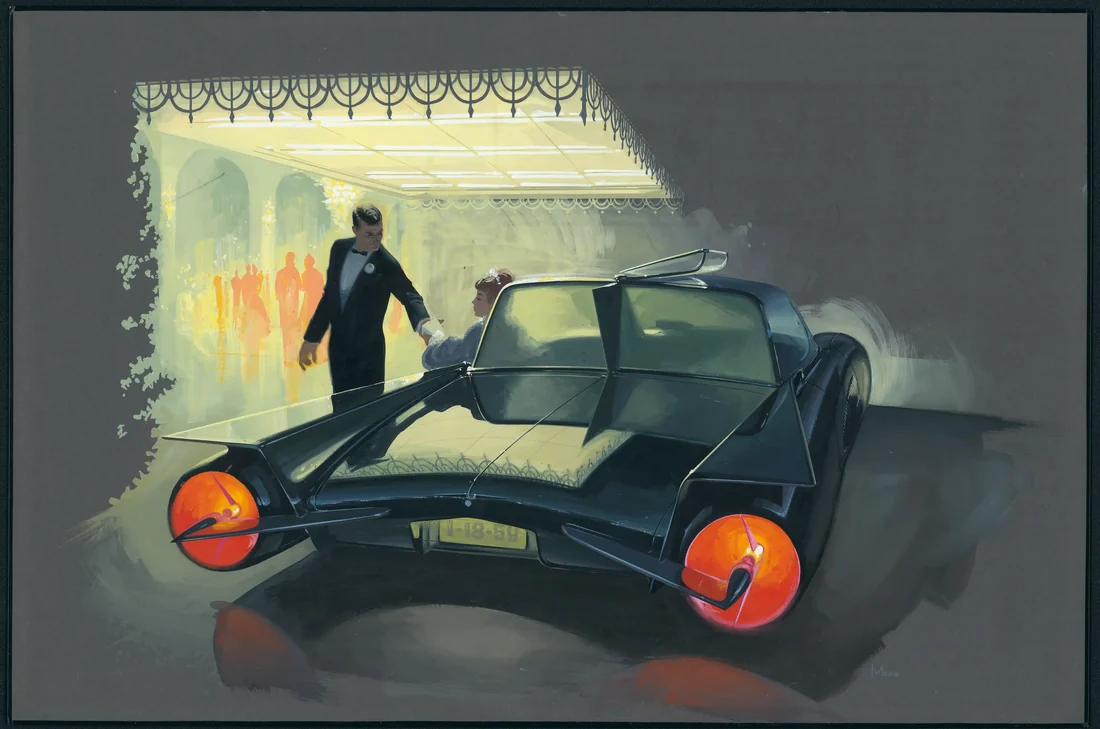

The image
The record at hand is a single line in a career timeline: Syd Mead's own published career timeline lists, under the year 1981, ‘Film concepts: Bladerunner.’ Blade Runner itself, per Warner Bros.'s own catalogue page, was released 25 June 1982. Mead's own site does not describe a specific illustration in prose; it records only the engagement and its year, which is itself the primary fact this entry can verify: Mead's contribution was logged, in his own recorded account, as concepts, a year ahead of release.
What the documents show
The distinction between concept work and the film's credited production design is stated by a separate record: the Academy of Motion Picture Arts and Sciences' own ceremony record for the 55th Academy Awards, retrieved via the Wayback Machine after the live Academy site returned a bot-detection challenge to automated retrieval, lists Blade Runner's Art Direction nomination as Lawrence G. Paull and David L. Snyder, with Set Decoration credited to Linda DeScenna. Mead's name does not appear in that Academy credit line. The two records, read together, separate two distinct, documented roles: Paull and Snyder held the credited art-direction post the Academy recognized, while Mead's own site frames his part as visual-futurist concept work supplied to the production.
Production context
Mead's site elsewhere describes his career using the trade label visual futurist, distinct from production designer throughout the entries this site can check. Editorially, that distinction is consistent with how the two early-1980s films Mead's timeline separately credits him on, Tron (1980, film concepts) and Blade Runner (1981, film concepts), are both logged the same way: as concept contributions to productions whose on-set art direction was executed and credited to others. This entry does not have access to a document describing which specific vehicles, buildings or streetscapes in the finished film trace to a Mead drawing, and does not claim more than his own site states.
Reference versus imitation
Treating Blade Runner's look as a single designer's signature would flatten a credit structure both of this entry's sources keep separate: a visual futurist supplying concepts, and a credited production design and art direction team responsible for what was actually built and photographed. A reference user citing Mead's influence on a later production should cite the concept role his own site claims, not the Academy-credited art direction role that belonged, by the Academy's own record, to Paull and Snyder.
- Is a Blade-Runner-inspired design tracing to Mead's documented concept work, or to the film's credited art direction team?
- Does a source distinguish visual-futurist concept credits from the production designer of record?
- Where an official ceremony record and a personal career site differ in emphasis, which role is each one actually documenting?
Mead's own one-line timeline entry and the Academy's separate credit listing agree on the film and the year while describing two different jobs; keeping that separation intact is the difference between citing a documented concept contribution and inflating it into full authorship.
Sources & reading trail
Mead's own timeline logging his 1981 Blade Runner engagement as 'Film concepts', distinct from production design.
Source published: Not established · Retrieved: 16 September 2026
Academy's own record naming Lawrence G. Paull and David L. Snyder, not Mead, as Blade Runner's Art Direction nominees.
Source published: Not established · Retrieved: 16 September 2026
Studio's own page confirming the film's 25 June 1982 release date.
Source published: Not established · Retrieved: 16 September 2026
Records, documentation and rulings establish the entry; the reference-versus-imitation reading is Screen Visual Lab editorial analysis. This retrospective draft does not imply the site published on the event date.