The image
The example at hand is a small production still hosted on Wikimedia Commons: File:Nosferatu.jpg, captioned as a screenshot or promotional photo from the 1922 film, showing Max Schreck and Gustav von Wangenheim. The file's own page states it was uploaded in 2007 and carries a specific public-domain rationale rather than a general assertion of free use.

What the documents show
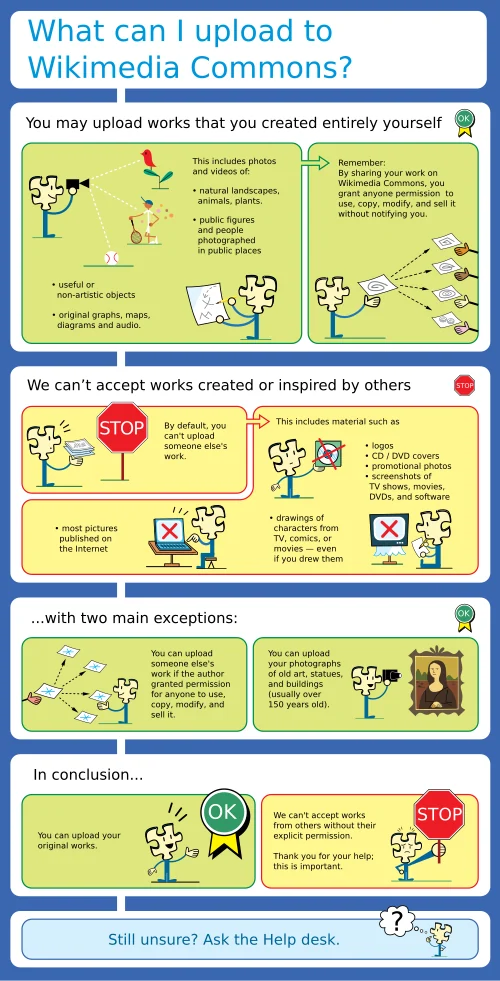
The file page states the image is in the public domain in the United States 'because it was published (or registered with the U.S. Copyright Office) before January 1, 1931,' applying the {{PD-1923}} tag, and separately notes it must also be public domain in its country of origin to be hosted on Commons. Commons's general Licensing policy page, a living document as retrieved on 16 September 2026, explains the underlying rule: in the United States, works published before 1931 are in the public domain, a threshold that advances each year, and the page recommends the Hirtle chart as a tool for working out a specific work's status. The file page applies exactly the rule the policy page states, giving a concrete example of the general policy in operation.
Production context
For a researcher assembling reference material from early cinema, this dating rule is what makes certain silent-era production stills usable without a separate license, provided the work's US publication date and country-of-origin status both clear the bar. Editorially, that caveat about country of origin matters for a German production like Nosferatu: Commons's policy states that non-US works must be public domain in their source country as well as the United States, so the same still could carry a different status in Germany, a distinction the general policy page draws but the file page does not fully resolve on its own.
Reference versus imitation
Commons's own documentation is careful to scope its rationale to the specific file it is attached to; the Licensing page states that public domain status must hold in all relevant jurisdictions, not just the US, before content is properly hosted. A researcher relying on a Commons still for production reference should read the file page's own tag and rationale rather than assuming that any pre-1931 image is automatically clear everywhere the researcher intends to use it, since the site's own rules explicitly qualify that claim.
- Does the file page state a specific rationale, or only an unsupported public-domain claim?
- Has the work's status in its country of origin been checked, not only its US status?
- Would the intended reuse require a different jurisdiction's copyright term to be checked?
Commons's Licensing policy and the Nosferatu file page together show how a general public-domain rule is applied to one specific, credited still, with country-of-origin status treated as a separate, necessary check rather than an afterthought.
Sources & reading trail
States that works published in the US before 1931 are in the public domain and that non-US works must also clear their source country's term.
Source published: Not established · Retrieved: 16 September 2026
Applies the pre-1931 US publication rule to a specific 1922 film still using the PD-1923 tag.
Source published: Not established · Retrieved: 16 September 2026
Records, documentation and rulings establish the entry; the reference-versus-imitation reading is Screen Visual Lab editorial analysis. This retrospective draft does not imply the site published on the event date.